Checked
History of Toronto, Ontario: from Tkaronto to the megacity
Toronto, Ontario, Canada
A clear history of Toronto, Ontario: thousands of years of Indigenous presence, the Toronto Purchase (Treaty 13), the Town of York, incorporation in 1834, the Great Fire, Metro Toronto and the 1998 amalgamation.
Key information
Indigenous peoples have lived in the Toronto area for thousands of years, and most of the city is covered by Treaty 13, the Toronto Purchase, with the Mississaugas of the Credit. The British founded the Town of York here in 1793, it became the City of Toronto in 1834, and today’s city was formed by merging six municipalities on January 1, 1998.
On this page
Toronto history timeline
| Year | Event |
|---|---|
| About 12,500 years ago | The ice sheet retreats and Indigenous peoples begin to hunt in the area |
| By 1300 | Iroquoian-speaking peoples have villages in the present-day Toronto area |
| 1720 | French traders build a small store on the Humber River |
| 1750 | The French build Fort Rouillé (Fort Toronto), on today’s Exhibition grounds |
| 1787 | First Toronto Purchase meeting at the Bay of Quinte; the deed is later found blank |
| 1793 | John Graves Simcoe lays out the Town of York and a garrison at Fort York |
| 1796 | Yonge Street opens, following the old Toronto Passage north |
| 1805 | The Toronto Purchase (Treaty 13) is renegotiated with the Mississaugas of the Credit |
| 1813 | United States forces attack and occupy York on April 27 |
| 1834 | York, with over 9,000 people, becomes the City of Toronto; William Lyon Mackenzie is first mayor |
| 1858 | A storm cuts the Toronto Islands off from the mainland |
| 1867 | Toronto becomes capital of the new province of Ontario |
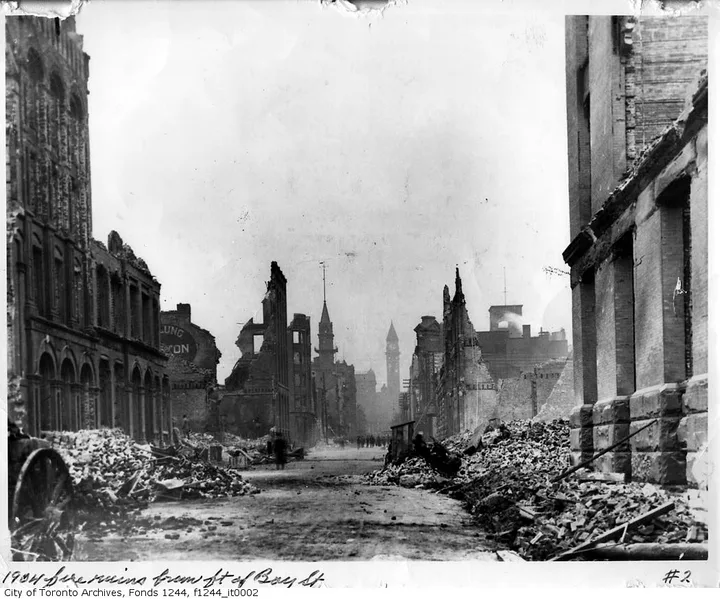
| 1904 | The Great Fire destroys at least 98 buildings downtown on April 19 |
| 1953 | Metropolitan Toronto, Canada’s first metropolitan government, is created |
| 1954 | Canada’s first subway opens (March 30); Hurricane Hazel kills 81 people (October 15 to 16) |
| 1965 | New City Hall opens on September 13 |
| 1976 | The CN Tower opens to the public on June 26 |
| 1998 | Toronto, York, East York, North York, Scarborough and Etobicoke merge on January 1 |
| 2010 | Canada settles the Toronto Purchase and Brant Tract claims for $145 million |
| 2015 | Toronto hosts the Pan American Games |
| 2018 | City Council is cut from 47 planned seats to 25 by provincial law |
Sources: Toronto | The Canadian Encyclopedia · The Toronto Purchase Treaty, No. 13 (1805) | Mississaugas of the Credit First Nation · History | Fort York National Historic Site · Toronto Islands | The Canadian Encyclopedia · Great Fire of Toronto (1904) | The Canadian Encyclopedia · Canada’s First Subway Opens | City of Toronto web exhibit · Hurricane Hazel | The Canadian Encyclopedia · Toronto City Hall | The Canadian Encyclopedia · CN Tower history | CN Tower · Pan American Games | The Canadian Encyclopedia
Indigenous presence, territory and Treaty 13
The City of Toronto acknowledges that the city is on the traditional territory of many nations, including the Mississaugas of the Credit, the Anishnabeg, the Chippewa, the Haudenosaunee and the Wendat peoples, and is now home to many diverse First Nations, Inuit and Métis peoples. It also acknowledges that Toronto is covered by Treaty 13 with the Mississaugas of the Credit, and by the Williams Treaties with several Mississauga and Chippewa bands.
People have lived here for a very long time. Small groups moved in to hunt caribou soon after the glaciers retreated about 12,500 years ago. By 1300, Iroquoian-speaking peoples had farming villages with longhouses in the area. Many later moved north to join the Wendat (Huron) Confederacy. After that confederacy was dispersed around 1650, the Haudenosaunee set up villages here, including two Seneca villages, and then Anishinaabe peoples, some of whom became known as the Mississauga, settled the area and were its main residents until the end of the 1700s.
The Toronto Purchase began with a 1787 meeting at the Bay of Quinte. The deed from that meeting was later found blank, with the chiefs’ marks on separate pieces of paper, and the Mississaugas opposed a 1788 survey. In 1805 the Crown renegotiated the purchase: about 250,830 acres for 10 shillings, with the Mississaugas keeping the right to fish on Etobicoke Creek. The Mississaugas of the Credit filed a claim in 1998, and in 2010 Canada settled the Toronto Purchase and Brant Tract claims for $145 million, at the time the largest claims settlement in Canadian history. The eastern part of the city falls under the 1923 Williams Treaties.
Sources: Land Acknowledgement | City of Toronto · Toronto | The Canadian Encyclopedia · The Toronto Purchase Treaty, No. 13 (1805) | Mississaugas of the Credit First Nation
How Toronto got its name
The word came from far north of today’s downtown. The Canadian Encyclopedia traces it to the Mohawk tkaronto, “where there are trees standing in the water,” which described the fish weirs that the Wendat and others built at the Narrows near present-day Orillia. French maps from the 1680s called Lake Simcoe “Lac de Taronto.” Over the 1700s the spelling became Toronto and the name drifted south to cover the route and region around the Toronto Passage. The City of Toronto’s fact page describes the name as a Huron word for “fishing weir,” so sources differ on the language but agree on the weirs.
When Simcoe laid out his town in 1793 he named it York, after the Duke of York, a son of King George III. Residents went back to the older Indigenous-derived name when the town was incorporated as the City of Toronto in 1834.
Sources: Toronto | The Canadian Encyclopedia · Toronto at a Glance | City of Toronto
The Town of York, 1793 to 1834
French traders knew the Toronto Passage, an old Indigenous trail between Lake Ontario and Georgian Bay, from the early 1600s. They ran a store on the Humber River from 1720 to 1730, and in 1750 built Fort Rouillé, which their own garrison burned in 1759 as British forces advanced.
After the American Revolution, Loyalists moved north and Upper Canada was created in 1791. Its first lieutenant governor, John Graves Simcoe, wanted a protected naval base on Lake Ontario. In 1793 he ordered a garrison built at what is now Fort York and had a small town laid out by the harbour. York soon became the capital of Upper Canada, and Yonge Street opened in 1796.
In the War of 1812, on April 27, 1813, about 2,700 American soldiers and sailors attacked York. They were met by about 750 British regulars, Canadian militia, Mississauga and Ojibwe warriors. The town was raided twice that year. Fort York was rebuilt between 1813 and 1815, and its buildings still stand.
Sources: Toronto | The Canadian Encyclopedia · History | Fort York National Historic Site
From a small city to a national centre, 1834 to 1945
By 1834 York had more than 9,000 people and was incorporated as the City of Toronto, with reform journalist William Lyon Mackenzie as first mayor. Three years later, Mackenzie led the failed Upper Canada Rebellion of 1837.
Gas lights, sewers and steamboats arrived in the 1840s, and railways in the 1850s linked Toronto to Montreal, New York, Georgian Bay, Detroit and Chicago. Toronto became the capital of Ontario at Confederation in 1867. The population grew five times over between 1831 and 1891, as factories like Massey’s farm machinery works and stores like Eaton’s boomed.
On the icy night of April 19, 1904, fire broke out in a building on Wellington Street. By the time it was out, at least 98 buildings in about 20 acres of the downtown industrial district were gone, with about $10 million in losses. Its cause was never solved. The fire pushed the city toward safer building rules.
By the 1920s Toronto had about half a million people and new suburbs around it. The Great Depression hit hard, and the Second World War brought back factory jobs in aircraft, electronics and precision machinery.
Sources: Toronto | The Canadian Encyclopedia · Great Fire of Toronto (1904) | The Canadian Encyclopedia · The Great Fire of 1904 | City of Toronto web exhibit
Metro Toronto, Hazel and the 1998 megacity
Greater Toronto passed one million people by 1951. In 1953 Ontario created Metropolitan Toronto, Canada’s first metropolitan government, to run big shared services for 13 municipalities. Canada’s first subway opened under Yonge Street on March 30, 1954.
On October 15 and 16, 1954, Hurricane Hazel dropped more than 200 mm of rain in 24 hours. Rivers flooded, 81 people died and nearly 1,900 families lost their homes. It remains Toronto’s worst natural disaster. Afterwards, conservation authorities, local governments and the province built a flood-control plan to reduce the risk from future storms.
New City Hall opened in 1965, the CN Tower opened in 1976 and immigration from the Caribbean, South Asia, East Asia and elsewhere reshaped the city from the 1970s on. On January 1, 1998, the province merged Toronto, York, East York, North York, Scarborough and Etobicoke into one city, often called the megacity. In 2018 a provincial law reduced City Council to 25 wards matching federal and provincial ridings. Toronto hosted the Pan American Games in 2015, and the Raptors’ 2019 championship parade filled the downtown streets.
Sources: Toronto | The Canadian Encyclopedia · Canada’s First Subway Opens | City of Toronto web exhibit · Hurricane Hazel | The Canadian Encyclopedia · Toronto City Hall | The Canadian Encyclopedia · CN Tower history | CN Tower · Pan American Games | The Canadian Encyclopedia · Toronto Raptors | The Canadian Encyclopedia
Historic places you can still visit
| Place | Built or opened | Why it matters |
|---|---|---|
| Fort York | Rebuilt 1813 to 1815 | Site of the 1793 garrison and the 1813 battle |
| The Grange | About 1817 | Early gentry mansion from the Town of York years |
| St. Lawrence Hall | 1850 | Public hall with shops below, near St. Lawrence Market |
| Osgoode Hall | Rebuilt 1857 to 1860 | Home of the Law Society of Upper Canada |
| University College, University of Toronto | 1859 | Landmark of the university’s main campus |
| Ontario Legislative Building, Queen’s Park | 1892 | Seat of Ontario’s government |
| Old City Hall | 1899 | Toronto’s city hall until 1965 |
| Royal Alexandra Theatre | 1907 | Historic King Street theatre |
| Union Station | 1927 | Grand railway station, still the city’s busiest transit hub |
| New City Hall | 1965 | Viljo Revell’s curved towers on Nathan Phillips Square |
Sources: Toronto | The Canadian Encyclopedia · Toronto City Hall | The Canadian Encyclopedia · PATH: Toronto’s Downtown Pedestrian Walkway | City of Toronto
Questions about Toronto’s history
When was Toronto founded?
The British laid out the Town of York in 1793, and it was incorporated as the City of Toronto in 1834. Indigenous peoples lived in the area for thousands of years before that.
What was Toronto called before it was Toronto?
It was the Town of York from 1793 until 1834, named after the Duke of York, a son of King George III.
Whose traditional territory is Toronto on?
The City acknowledges the traditional territory of many nations, including the Mississaugas of the Credit, the Anishnabeg, the Chippewa, the Haudenosaunee and the Wendat peoples.
What is the Toronto Purchase?
It is Treaty 13 between the Crown and the Mississaugas of the Credit. It began in 1787, was renegotiated in 1805 for about 250,830 acres for 10 shillings, and was settled by Canada in 2010 as part of a $145 million claims settlement.
Source: The Toronto Purchase Treaty, No. 13 (1805) | Mississaugas of the Credit First Nation
Who was Toronto’s first mayor?
William Lyon Mackenzie, a reform journalist, became the first mayor in 1834. He led the failed Upper Canada Rebellion in 1837.
When did Toronto become a megacity?
On January 1, 1998, when the Province merged Toronto, York, East York, North York, Scarborough and Etobicoke into one city.
What happened in the Great Fire of Toronto?
On April 19, 1904, a fire starting on Wellington Street destroyed at least 98 downtown buildings in about 20 acres. Its cause was never solved.
Source: Great Fire of Toronto (1904) | The Canadian Encyclopedia
How bad was Hurricane Hazel in Toronto?
Hurricane Hazel hit on October 15 and 16, 1954, with more than 200 mm of rain in 24 hours. It killed 81 people and left nearly 1,900 families homeless.
What happened at the Battle of York?
On April 27, 1813, about 2,700 American troops attacked York, defended by about 750 British, Canadian, Mississauga and Ojibwe fighters. York was occupied and raided.
When did Toronto become the capital of Ontario?
Toronto became the capital of the new province of Ontario at Confederation in 1867. Before that, as York, it was the capital of Upper Canada.