Checked
Toronto short-term rental hosts: principal residence, registration and tax
Toronto, Ontario, Canada
Toronto short-term rentals cover paid stays shorter than 28 consecutive days in the operator’s principal residence.
Key information
Toronto short-term rentals cover paid stays shorter than 28 consecutive days in the operator’s principal residence. Register before advertising, and choose either an entire-unit or partial-unit registration.
On this page
Choose one registration type
| Type | What can be rented | Night rule |
|---|---|---|
| Entire unit | The operator’s whole principal dwelling | Maximum 180 nights per calendar year |
| Partial unit | Up to three bedrooms, and one fewer than the home’s total bedrooms | Unlimited nights only under applicable partial-unit rules |
| Separate investment property | Not eligible as the operator’s short-term rental | Principal residence requirement applies |
| Secondary/laneway/garden suite | Only when that suite is the operator’s principal residence | Main-house residence does not make another suite eligible |
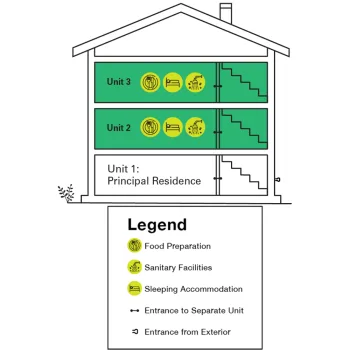
Sources: Short-Term Rental Operators/Hosts
Key checks at a glance
- Eligibility and ID
Operators must be at least 18 and live at the registered principal residence.
- Fee, renewal and switching types
The current operator page lists a non-refundable $390 registration fee, subject to annual increase.
- Guest information and accommodation tax
Display physical emergency contact details and exit diagrams prominently during a stay.
Sources: Short-Term Rental Operators/Hosts · Short-Term Rental Municipal Accommodation Tax
Eligibility and ID
Operators must be at least 18 and live at the registered principal residence. Only one registration is allowed per dwelling unit. Owner or tenant status alone is not enough; bills, ID, taxes and insurance should support where the person actually lives.
Registration requires a valid Ontario driver’s licence or Ontario Photo Card with matching name and address, and two additional principal-residence documents. Examples include utility bills, lease or purchase agreements, vehicle insurance, tax notices and financial or employment statements. After applying for new government ID, wait at least two business days before registering.
Condominium rules can prohibit rentals. The city does not collect landlord consent as a registration requirement, but a tenant must consider the lease and tenancy rules. A municipal registration does not resolve a private lease dispute.
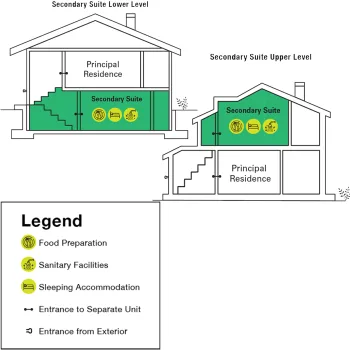
Sources: Short-Term Rental Operators/Hosts
Garden suite rental illustration
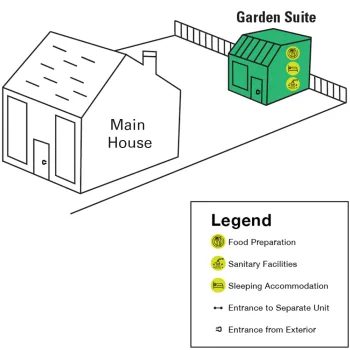
Sources: City of Toronto: official example
Laneway suite rental illustration
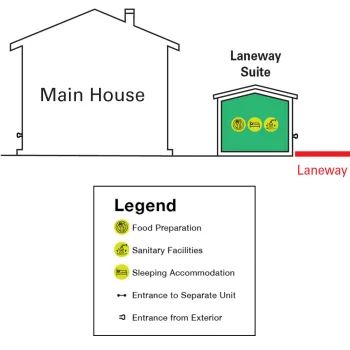
Sources: City of Toronto: official example
Fee, renewal and switching types
The current operator page lists a non-refundable $390 registration fee, subject to annual increase. If approved, the registration lasts one year from approval. Operators register themselves and renew annually.
The type stays fixed for the registration term and can change only at renewal. Once a property is registered entire-unit within a calendar year, the 180-night limit counts partial-unit as well as entire-unit nights in that year. For example, 150 earlier partial nights leave 30 entire-unit nights, not 180 new nights.
Sources: Short-Term Rental Operators/Hosts
Guest information and accommodation tax
Display physical emergency contact details and exit diagrams prominently during a stay. Advertise and rent only in the registered type. A partial-unit host remains living at home and cannot simultaneously offer the entire dwelling.
As of August 1, 2026, Municipal Accommodation Tax is 6%; the temporary 8.5% rate ended. Registered operators must file a report each reporting period, even if a platform collected the tax or no tax was collected. Quarterly payment is due within 30 days after the quarter. Keep the host-registration and tax-reporting tasks separate.
Sources: Short-Term Rental Operators/Hosts · Short-Term Rental Municipal Accommodation Tax
Questions and answers
Can I register my investment condo if I live elsewhere?
No. Only the operator’s principal residence qualifies.
What counts as a short stay?
Less than 28 consecutive days for payment.
Can two roommates each register the same unit?
No. Only one registration is permitted per dwelling unit.
Can a main-house resident rent the laneway suite?
Not as their own short-term rental unless the suite itself is their principal residence.
Can I switch to entire-unit halfway through my term?
The type can change only at renewal.
Do previous partial nights count after switching?
Yes. Once entire-unit rules apply in that calendar year, combined rental nights count toward 180.
What ID is accepted for registration?
An Ontario driver’s licence or Ontario Photo Card with matching principal-residence details.
How much is the listed registration fee?
$390, non-refundable and subject to annual increase.
What MAT rate applies from August 2026?
6%, after the temporary 8.5% increase ended.
Must I file if the platform collected MAT?
Yes. Registered operators file a report for every reporting period.